

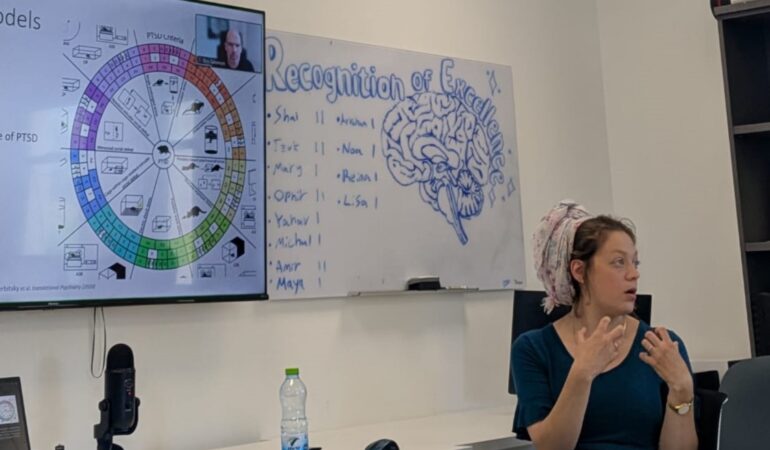
Guest Lecture: Investigating MDMA Effects on PTSD via Reverse-Translational Mouse Models
We were delighted to host Hadas Catane Hovav, a PhD student from Prof. Gali Umschweif-Nevo’s lab at the Hebrew University of Jerusalem, for a fascinating guest lecture in our lab. Hadas is leading an exciting reverse-translational collaboration with our team. This approach takes real-world human data collected in our lab’s project with Nova festival survivors,
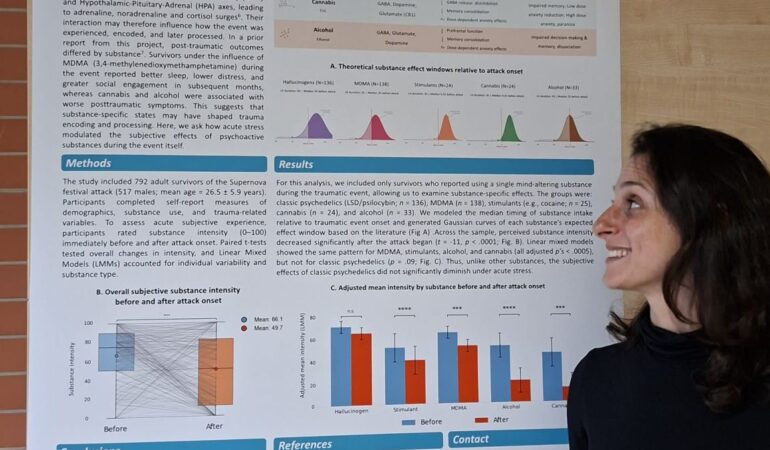
Psychedelic Neuroscience Prague workshop at NUDZ
Our lab was well-represented at the recent Psychedelic Neuroscience Prague workshop hosted by NUDZ, where researchers gathered to discuss the latest advancements in psychedelic research and trauma. Prof. Roy Salomon presented our lab’s ongoing work on the Nova cohort, sharing longitudinal data on trauma and recreational psychedelic use in real-world settings. His talk highlighted key
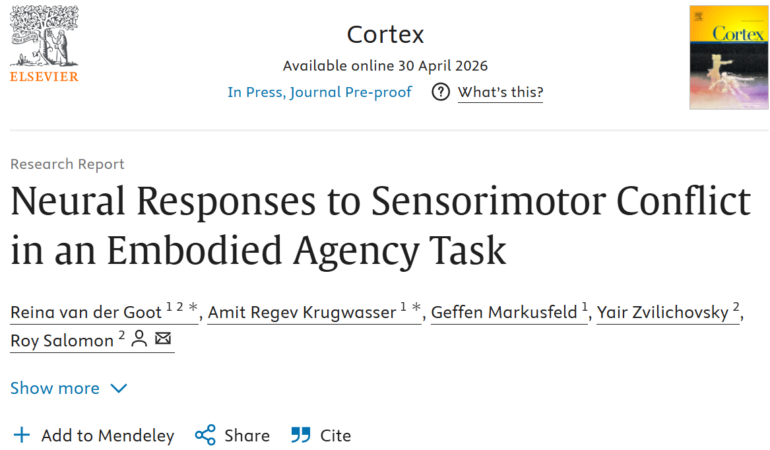
New Publication in Cortex: Uncovering the Neural Dynamics of the Sense of Agency
New Publication in Cortex: “Neural Responses to Sensorimotor Conflict in an Embodied Agency Task” We are thrilled to share our new paper published in Cortex, by Reina van der Goot, Amit Regev Krugwasser, Geffen Markusfeld, Yair Zvilichovsky, and Prof. Roy Salomon! Using an established Virtual Reality (VR) paradigm in combination with EEG, we introduced sensorimotor
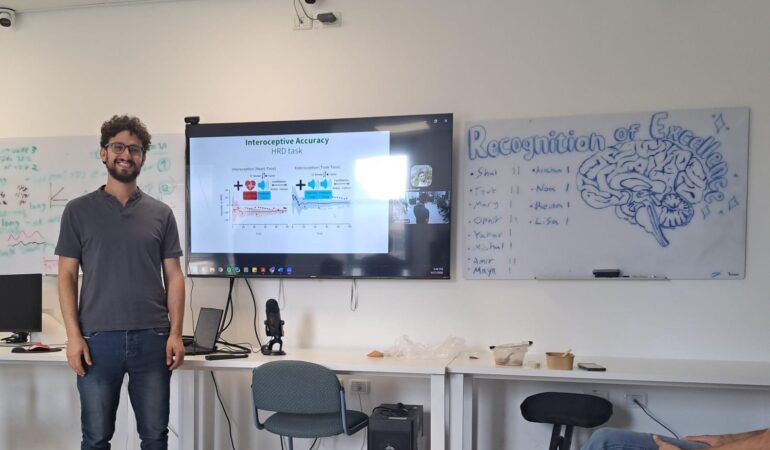
SLAB Is Back to Routine
This Monday, we held our first in-person lab meeting after a long period without a regular routine. It was exciting to finally reconnect face-to-face, and a clear sense of joy and relief filled the room. During the meeting, Avraham, a PhD student in the lab, presented findings from his project on interoception in the context

Salomon Lab @ ISCoP 2026, Akko
Ophir Netzer and Dr. Lisa Simon took the stage at ISCoP 2026, the annual Israeli Conference on Cognition Research, held this year in Akko. PhD student Ophir Netzer opened with a talk exploring the subjective experience of acute stress during psychoactive states among Nova festival survivors. Building on her earlier findings, which showed that early

Dr Lisa Simon Presents at the K.M.H. Institute Inaugural Conference, Achva Academic College
On January 27th, postdoctoral researcher Lisa Simon represented the Salomon Lab at the inaugural conference of the K.M.H. Institute for Research and Development (Community, Meaning, Recovery) at Achva Academic College. The conference, titled “Rising Together, Rebuilding: On Meaning, Community, Trauma, and Recovery,” brought together leading researchers and clinicians to address the psychological challenges facing Israeli
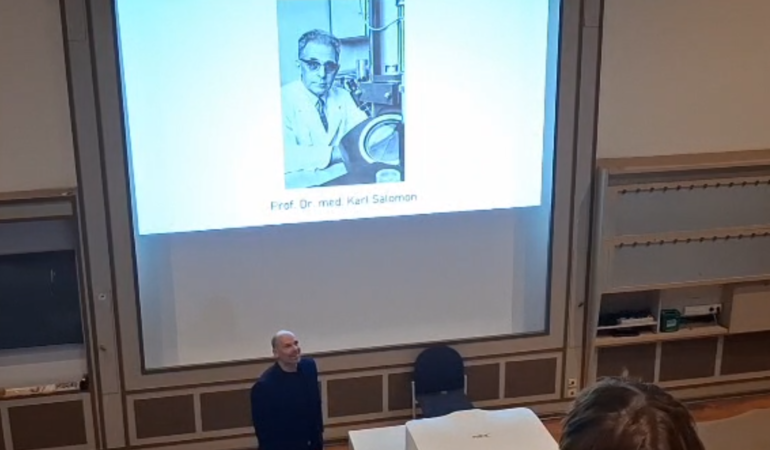
Roy Salomon Presents NOVA Survivors Research at Charité – Universitätsmedizin Berlin
On December 16, Dr. Roy Salomon delivered an invited talk at Charité – Universitätsmedizin Berlin, presenting recent findings from the NOVA survivors project. His lecture focused on trauma exposure, long-term psychological consequences,and psychedelics. Dr. Salomon opened his presentation with a personal reflection on his family’s history at the Charité. In 1933, his grandfather, Professor Dr. Karl

Slab celebrates HanuChristmas!
The Slab celebrated HanuChristmas with a warm and joyful evening at the home of our PhD student, Avraham. We lit the Hanukkah candles together, prepared delicious sufganiot, enjoyed a beautifully decorated Christmas tree, and shared hot wine. It was a lovely evening of shared traditions and good company!
Introducing the Psychedelic Watches Project: Mapping the Physiology of Psychedelic-Assisted Therapy
Our lab is leading an innovative multi-site research initiative aimed at uncovering the physiological signatures of psychedelic-assisted therapy. This project, led by postdoctoral researcher Dr. Lisa Simon and MA student Mary Grankin, is currently underway at several leading psychiatric hospitals and clinics across Israel, where clinical trials are investigating psychedelic treatments for PTSD, treatment-resistant depression,
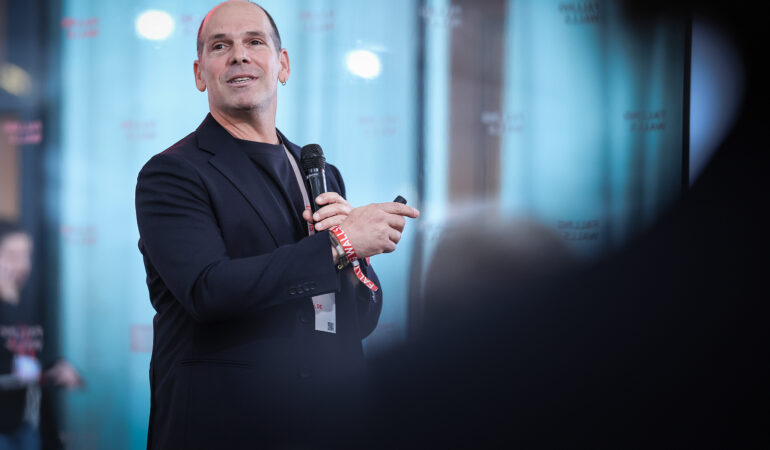
Prof. Roy Salomon Presents at the Falling Walls Science Summit, Berlin
On November 6th, Prof. Roy Salomon participated in the Falling Walls Science Summit in Berlin, speaking in the session “Breaking the Walls of Trauma: Psychedelics and Recovery.” The event brought together leading researchers and clinicians to discuss emerging evidence on psychedelic-assisted therapies and their potential role in treating trauma-related disorders. Prof. Salomon joined Dr. Dimitris Repantis (Charité